MEA’s Cost of Power Adjustment (COPA) Increasing for 3Q 2026
At a Glance
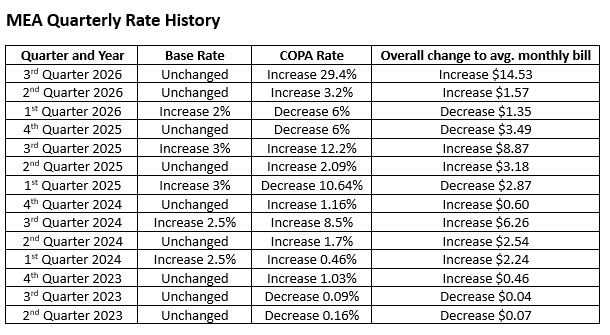
• The Cost of Power Adjustment (COPA) is increasing by approximately $0.02316, or 29.4% beginning in the third quarter of 2026. The COPA rate will increase from $0.07879/kWh to $0.10195/kWh due to higher fuel and power supply costs with increased natural gas usage related to a colder than expected spring.
• The COPA makes up about 37% of a member’s bill, so a typical residential member using 623 kWh per month will see their monthly bill increase by approximately $14.53. This represents an increase of about 9.26% compared to the second quarter of 2026.
• MEA's Board of Directors approved no change to base rates for the third quarter. The increase is primarily related to the Cost of Power Adjustment (COPA), which reflects the actual cost of fuel and purchased power that flow through to MEA members as a direct pass through without any additional markup.
_______________________________________________________________________________________________________________
Understanding the COPA
MEA members will see an increase in the Cost of Power Adjustment (COPA) beginning in the third quarter of 2026, reflecting higher fuel and power supply costs experienced this spring and projected for the months ahead.
The COPA is the portion of your electric bill that reflects the actual cost of fuel and purchased power used to provide electricity. Unlike base rates, which cover the operation, maintenance, and improvement of MEA’s electric system, the COPA changes as fuel and power supply costs rise or fall and are directly passed through to MEA members without any markup as costs are incurred.
Fuel and purchased power currently account for approximately 37% of the average residential electric bill. As a result, significant increases or decreases in these costs can have a meaningful impact on monthly bills, even when base rates remain unchanged. Part of the COPA also involves a balancing account which is essentially a running true-up. It tracks the difference between the projected cost of power and what it actually costs, so any over-collection is returned to members and any shortfall is recovered over time.
For the upcoming quarter, MEA’s COPA rate will increase from $0.07879 per kilowatt-hour(kWh) to $0.10195 per kWh, an increase of approximately 29.4%.
What Will this Mean for my Bill?
For a typical residential member using 623 kWh per month, the average monthly electric bill is expected to increase by approximately $14.53, or 9.26%, compared to the second quarter of 2026.
It is important to note that the MEA Board of Directors approved no change to base rates for the third quarter. Base rates are reviewed separately and cover the costs of operating and maintaining MEA's electric system. The increase members will see this quarter is primarily related to higher fuel and purchased power costs reflected in the COPA.
What Is Driving the Increase?
Several factors contributed to the increase, with the largest factor being driven by a shortfall in the balancing account, related to higher-than-expected fuel usage caused by a colder than expected spring. Other factors include higher fuel costs, reduced access to lower-cost power, new natural gas storage fees, and lower projected summer energy sales.
Higher Fuel Usage During a Colder-Than-Expected Spring
The balancing account tracks the difference between projected and actual power supply costs. During the March through May period, colder temperatures increased electricity demand, resulting in greater fuel consumption at higher fuel prices than originally forecast.
While higher energy sales helped offset some of these costs, actual fuel expenses exceeded projections and increased the amount that must now be recovered through the COPA.
Reduced Access to Lower-Cost Power and Hydroelectric Generation
MEA participates in a power pool with neighboring Railbelt utilities that allows utilities to buy and sell electricity among one another when lower-cost power is available. This spring, maintenance outages at power plants owned by neighboring utilities reduced the amount of lower-cost electricity available through these power-sharing arrangements. At the same time, lower water inflows reduced hydroelectric generation across the Railbelt.
With fewer opportunities to purchase lower-cost power and less hydroelectric energy available, MEA relied more heavily on higher cost natural gas generation to meet member demand.
New Natural Gas Storage Costs
Beginning in April 2026, MEA also began incurring new natural gas storage fees associated with Hilcorp’s gas storage services. These costs total approximately $170,000 per month and are now being included in the COPA calculation.
As a result, the fuel component of the COPA is increasingfrom $0.06448 per kWh to $0.07142 per kWh.
Increased Purchased Power Costs
Purchased power costs are also rising for the third quarter. The increase is primarily driven by higher projected hydroelectric purchases from the Eklutna Power Purchase Agreement during the summer months, modest increases in Bradley Lake power purchases, and higher transmission wheeling charges resulting from recent rate adjustments.
The purchased power component of the COPA is increasingfrom $0.01573 per kWh to $0.01934 per kWh.
Lower Summer Energy Sales Forecast
Projected summer energy sales are lower than in previous quarters. Because power supply costs are spread across fewer kilowatt-hours sold, the per-kWh recovery amount increases even when costs remain relatively stable.
Why Does MEA Use a COPA?
The COPA is designed to ensure that the actual cost of fuel and purchased power is passed through to members without any additional markup for the cooperative.
When fuel and power supply costs are lower than expected, the COPA decreases and members benefit from lower charges. When costs rise, the COPA increases to recover those expenses. This approach helps keep MEA's base rates more stable while ensuring members pay the actual cost of power.
Looking Ahead
As the balancing account in the COPA stabilizes and the temporary shortfall is recovered, MEA expects the COPA to decrease, assuming fuel prices, purchased power costs, and member energy usage are generally consistent with current projections.
MEA continues to actively manage power supply costs through long-term fuel contracts, regional power-sharing agreements, hydroelectric resources, battery storage, and operational efficiencies. While most factors affecting power costs are outside of MEA’s control, the cooperative remains focused on providing safe, reliable, and affordable electric service to our members.
Click here to see the full 3rd Quarter 2026 Rate Sheet